
Why integration fails quietly and how to design it out from day one?
Updated: Apr 28

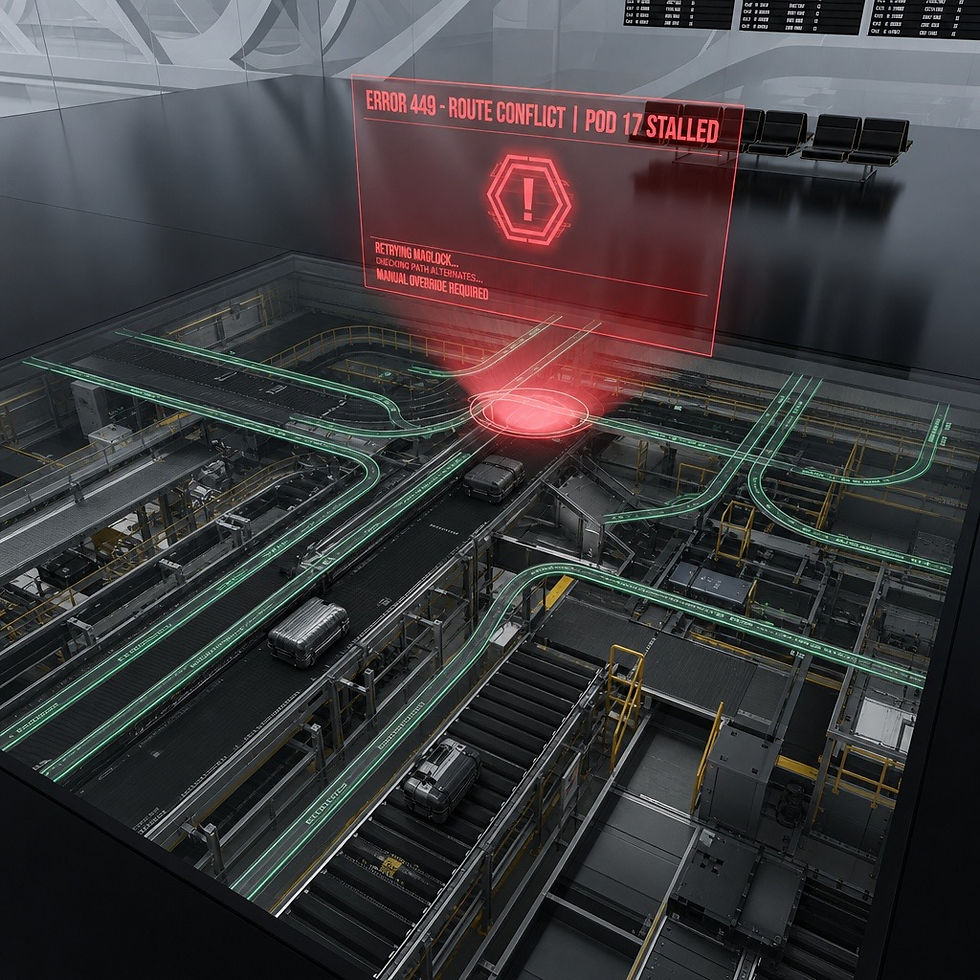
In most airport programmes, failure does not arrive as a single, visible event. It builds slowly, in the gaps between systems.
A conveyor performs as designed. A screening system meets its specification. A control system passes its factory tests. On paper, everything works. Yet when these elements are brought together in a live environment, performance becomes unpredictable. Bags hesitate, messages misalign, and operational teams begin compensating for behaviour the system was never meant to exhibit.
This is not a technology problem. It is an integration problem.
Too often, integration is treated as a phase. Something that happens after design, after procurement, after individual systems have been validated in isolation. By that point, the opportunity to influence how those systems interact has already narrowed. What follows is a period of intensive testing, defect discovery and workaround creation, all under increasing time pressure.
The result is familiar. Commissioning becomes reactive. Root causes are difficult to isolate. And confidence in the system is built late, rather than designed in early.
At vLogix, integration is treated as a continuous discipline that starts at the concept stage and runs through to operation. The focus is not on connecting systems at the end, but on ensuring they are designed to work together from the outset.
This begins with clarity. Not just what each system is required to do, but how they are expected to behave together. Data exchanges, control logic, timing dependencies and failure modes need to be defined as part of the design intent, not left to be interpreted during delivery.
From there, that intent needs to be validated before physical systems are in place.
This is where high-fidelity simulation becomes critical. A physics-based digital twin of the baggage system allows interactions to be tested in a realistic environment, long before commissioning. Bags move with real-world constraints. Diverters, merges and chutes behave as they would on site. Control logic can be exercised under normal and abnormal conditions.
This is not about visualisation. It is about evidence.
By simulating real operational scenarios early, integration issues can be identified when they are still easy to resolve. Control strategies can be refined. Throughput assumptions can be challenged. Edge cases, which are often the source of disruption in live operations, can be explored in detail.
Equally important is how testing is structured.
Rather than treating System Test and Integration as a final gateway, it should be aligned with the design from the outset. Test scenarios should reflect real operational use, not just technical functions. Success criteria should be clearly defined and traceable back to requirements. When physical testing begins, it should confirm expected behaviour, not uncover unknowns.
This approach changes the nature of commissioning. Instead of a compressed period of discovery, it becomes a controlled process of validation.
There is also a governance dimension that is often overlooked. In complex programmes, multiple stakeholders contribute to delivery, each with their own priorities and interpretations of requirements. Without a consistent reference point, design intent can drift.
Maintaining that intent requires independent oversight. A role that ensures what is being designed, built and tested remains aligned with the original objectives and operational needs. Not just technically compliant, but operationally meaningful.
When integration is treated this way, several things change.
Issues are identified earlier, when they are less costly to resolve. Testing becomes more predictable. Stakeholders have clearer visibility of system behaviour. And perhaps most importantly, operational teams inherit a system that behaves as expected from day one.
Airports are complex, high-pressure environments. Baggage systems sit at the centre of that complexity, connecting infrastructure, technology and people. Success is not defined by individual components performing well in isolation, but by the system working reliably as a whole.
Integration is where that outcome is decided.
Design it early, validate it continuously, and prove it with evidence. That is how uncertainty is removed from delivery, and how systems move from theoretical performance to operational reality.
For organisations facing integration challenges in active or upcoming programmes, this is where structured oversight and early validation make the difference. vLogix supports this process by bringing clarity to design intent, alignment to delivery, and predictability to integration.


Comments